

This audio is auto-generated. Please let us know if you have feedback.
The U.S. Supreme Court ruled on Tuesday that transgender student athletes do not have the constitutional right to play on sports teams aligning with their gender identity. Instead, colleges and K-12 schools can determine eligibility for women’s and girls’ sports teams based on “biological sex,” the court said.
The high court’s conservative majority said the two states being challenged over laws barring transgender women and girls from playing on sports teams that align with their gender identity did not violate the 14th Amendment’s right to equal protection under the law.
Justice Brett Kavanaugh wrote in the majority opinion that the equal protection clause allows colleges to maintain sports teams separated by “biological sex.”
googletag.display(‘dfp-hybrid1-mobile’)); googletag.pubads().addEventListener(‘slotRenderEnded’, function (event) { var adUnitPath = ‘/3618/highereddive/highereddivehybrid1’; var onProformative = false; if (onProformative && event.slot.getAdUnitPath() === adUnitPath && !event.isEmpty ) { var adUnitPathWithVisibility = adUnitPath + ‘-mobile’; var selector = ‘.pf-comments__ad-wrapper #dfp-hybrid1-mobile’; if (!$(selector).closest(‘.pf-comments__ad-wrapper’).hasClass(‘borders’)) { $(selector).closest(‘.pf-comments__ad-wrapper’).addClass(‘borders’) } } }); } }); }); ]]>
googletag.display(‘dfp-hybrid2-desktop’)); googletag.pubads().addEventListener(‘slotRenderEnded’, function (event) { var adUnitPath = ‘/3618/highereddive/highereddivehybrid2’; var onProformative = false; if (onProformative && event.slot.getAdUnitPath() === adUnitPath && !event.isEmpty ) { var adUnitPathWithVisibility = adUnitPath + ‘-desktop’; var selector = ‘.pf-comments__ad-wrapper #dfp-hybrid2-desktop’; if (!$(selector).closest(‘.pf-comments__ad-wrapper’).hasClass(‘borders’)) { $(selector).closest(‘.pf-comments__ad-wrapper’).addClass(‘borders’) } } }); } }); }); ]]>
“That policy is constitutionally justified by the vitally important interests in safety and competitive fairness so as to provide equal opportunities for women and girls to participate in sports,” Kavanaugh wrote.
Tuesday’s ruling stems from lawsuits brought by transgender students fighting laws in two states: Idaho and West Virginia.
In both cases, the plaintiffs argued that their respective state’s law violated the equal protection clause. The student fighting West Virginia’s law also argued that the statute violates Title IX, which bars sex-based discrimination in federally funded education programs.
The high court’s majority ruling — joined by Chief Justice John Roberts and the other three conservative justices — also found that West Virginia did not violate Title IX.
Justice Sonia Sotomayor, writing for the court’s liberal minority, said in a separate opinion that the plaintiff’s Title IX argument “fails, although on a narrower basis than that on which the majority relies.”But she dissented, she said, because the majority ruling “inflicts a hardship on those it disfavors without giving them the fair and full opportunity the Constitution requires to litigate their contentions.”
“These circumstances demand exercising judicial restraint, not rushing to answer conclusively difficult questions without sufficient evidentiary development,” Sotomayor wrote.
The ruling will have a major impact on colleges and K-12 schools nationwide.
Twenty-seven states have laws on the books that bar transgender students from playing on sports teams that align with their gender identity, according to Movement Advancement Project, a progressive think tank. Another two have state regulations or policies that do the same.
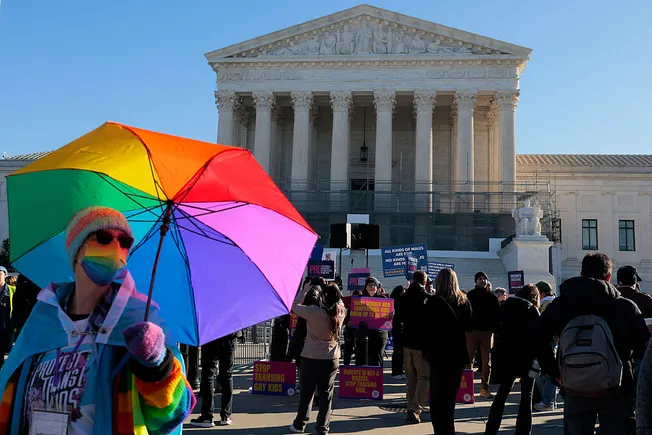
The Supreme Court in January heard oral arguments over the Idaho and West Virginia cases decided Tuesday.
googletag.display(‘dfp-hybrid2-mobile’)); googletag.pubads().addEventListener(‘slotRenderEnded’, function (event) { var adUnitPath = ‘/3618/highereddive/highereddivehybrid2’; var onProformative = false; if (onProformative && event.slot.getAdUnitPath() === adUnitPath && !event.isEmpty ) { var adUnitPathWithVisibility = adUnitPath + ‘-mobile’; var selector = ‘.pf-comments__ad-wrapper #dfp-hybrid2-mobile’; if (!$(selector).closest(‘.pf-comments__ad-wrapper’).hasClass(‘borders’)) { $(selector).closest(‘.pf-comments__ad-wrapper’).addClass(‘borders’) } } }); } }); }); ]]>
In one case, Little v. Hecox, a transgender woman attending Boise State University sued in 2020 over the ban in Idaho — the first state to pass a law restricting transgender students’ participation in sports. Lindsay Hecox won a lower court order blocking the law later that year, a ruling that a federal appeals court partially upheld in 2024.
However, Hecox in September asked the Supreme Court to dismiss her case as moot. Her lawyers explained in a brief last November that Hecox stopped participating in any college sports to focus on finishing college “without the extraordinary pressures of this litigation and related public scrutiny.”
The other case, West Virginia v. B.P.J., centers on Becky Pepper-Jackson, now a high school student. She and her mother sued West Virginia in 2021 over its ban barring transgender girls from playing on girls’ sports teams.
The 4th U.S. Circuit Court of Appeals handed down a ruling in 2023 allowing Pepper-Jackson, who has identified as a girl since the 3rd grade and takes puberty blockers, to participate in girls’ sports.
The Supreme Court ruled Tuesday that neither Idaho nor West Virginia violated the 14th amendment by keeping its sports teams for women and girls open exclusively to cisgender athletes.
Student and human rights advocates expressed disappointment over the high court’s decision.
Kelley Robinson, president of the Human Rights Campaign, on Tuesday called the ruling heartbreaking.
“When politicians convince the public that any girl could be ‘the wrong kind of girl,’ they invite harassment, intimidation, invasive questioning, or even an inspection of their body by a total stranger,” Robinson said in a statement. “It’s sadly just the latest decision by the conservative justices on the Supreme Court to roll back protections for marginalized communities and create a second class citizenship for millions of people.”
The National Women’s Law Center raised similar concerns.
“By allowing these states to exclude transgender women and girls like Becky Pepper-Jackson and Lindsay Hecox from school sports, the court has endorsed discrimination and reinforced the same stereotypes that Title IX was designed to dismantle,” Fatima Goss Graves, president and CEO of thecenter, said in a statement Tuesday.
But Shiwali Patel, the center’s senior director of education justice, noted that the ruling “affirms that Title IX does not federally require the exclusion of trans athletes.”
“This means that states with trans-inclusive policies are in compliance with Title IX, affirming that the Trump administration’s attacks on schools that welcome trans student athletes have no basis in law,” Patel said.
In contrast, U.S. Secretary of Education Linda McMahon touted the Supreme Court’s decision as upholding the Trump administration’s interpretation of Title IX.
“Today’s ruling cements those reforms and builds on decades of work to secure equal educational opportunities for women and girls,” she said in a statement.
President Donald Trump has targeted transgender rights since first taking office in 2017 and has been a vocal proponent of bans on transgender athletes.
In the early days of his second term, he signed an executive order that threatened to pull federal funding from colleges and K-12 schools that allow transgender girls and women to play on sports teams aligning with their gender identity.
Since then, the U.S. Department of Education has opened civil rights investigations into numerous colleges and K-12 schools, including the University of Pennsylvania and San Jose State University, over their policies for transgender students on sports teams.
googletag.display(‘dfp-hybrid4-desktop’)); googletag.pubads().addEventListener(‘slotRenderEnded’, function (event) { var adUnitPath = ‘/3618/highereddive/highereddivehybrid4’; var onProformative = false; if (onProformative && event.slot.getAdUnitPath() === adUnitPath && !event.isEmpty ) { var adUnitPathWithVisibility = adUnitPath + ‘-desktop’; var selector = ‘.pf-comments__ad-wrapper #dfp-hybrid4-desktop’; if (!$(selector).closest(‘.pf-comments__ad-wrapper’).hasClass(‘borders’)) { $(selector).closest(‘.pf-comments__ad-wrapper’).addClass(‘borders’) } } }); } }); }); ]]>
Penn faced a federal investigation over Lia Thomas, a transgender woman who participated on the university’s women’s swimming team in the 2021-22 season. Last summer, the Ivy League institution struck a deal with the Trump administration that included issuing apologies to cisgender women swimmers and transferring Thomas’ titles and awards to those that had lost to her.
Then, in January, the Education Department issued a finding that San Jose State violated Title IX by allowing a transgender woman to play on its volleyball team between 2022 and 2024. The agency has threatened to pull funding from the institution unless it agreed to a sweeping settlement.
In response, the California State University system, which oversees San Jose State, sued the Trump administration in March, calling its findings a “lawless overreach.