
This audio is auto-generated. Please let us know if you have feedback.
SAN DIEGO — Though the long-term effects of artificial intelligence on the job market remain to be seen, the rapidly developing technology has already begun changing how employers discuss work and hiring. Colleges now face the daunting task of preparing students for occupations that could look radically different in a relatively short timeframe.
A 2025 report from the Georgetown University Center on Education and the Workforce found that the rapid implementation of AI could simultaneously ease and worsen skills shortages, reducing the need for workers to complete some routine cognitive tasks but prompting demand for advanced technical and adaptive skills.
googletag.display(‘dfp-hybrid1-mobile’)); googletag.pubads().addEventListener(‘slotRenderEnded’, function (event) { var adUnitPath = ‘/3618/highereddive/highereddivehybrid1’; var onProformative = false; if (onProformative && event.slot.getAdUnitPath() === adUnitPath && !event.isEmpty ) { var adUnitPathWithVisibility = adUnitPath + ‘-mobile’; var selector = ‘.pf-comments__ad-wrapper #dfp-hybrid1-mobile’; if (!$(selector).closest(‘.pf-comments__ad-wrapper’).hasClass(‘borders’)) { $(selector).closest(‘.pf-comments__ad-wrapper’).addClass(‘borders’) } } }); } }); }); ]]>
googletag.display(‘dfp-hybrid2-desktop’)); googletag.pubads().addEventListener(‘slotRenderEnded’, function (event) { var adUnitPath = ‘/3618/highereddive/highereddivehybrid2’; var onProformative = false; if (onProformative && event.slot.getAdUnitPath() === adUnitPath && !event.isEmpty ) { var adUnitPathWithVisibility = adUnitPath + ‘-desktop’; var selector = ‘.pf-comments__ad-wrapper #dfp-hybrid2-desktop’; if (!$(selector).closest(‘.pf-comments__ad-wrapper’).hasClass(‘borders’)) { $(selector).closest(‘.pf-comments__ad-wrapper’).addClass(‘borders’) } } }); } }); }); ]]>
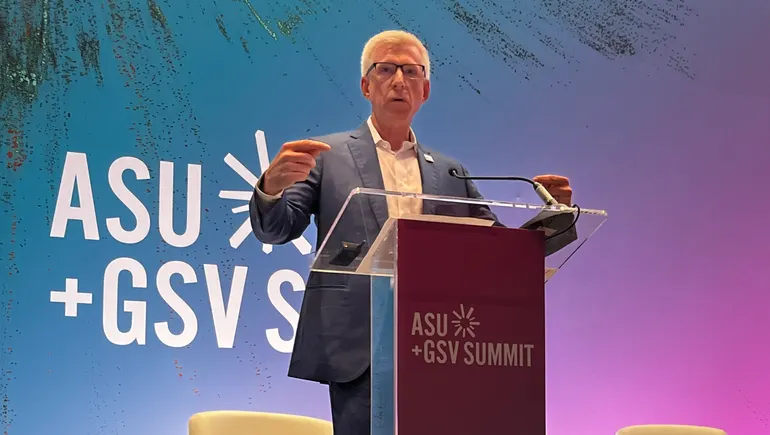
College leaders and higher education experts at the annual ASU+GSV Summit this week shared their experiences on teaching students AI-resilient skills and partnering with businesses to prepare them for the next generation of workforce needs.
Offering students resilient workforce skill sets
One of higher ed’s most repeated concerns about AI’s evolving abilities is how to prepare students for a workforce that could look significantly different by the time they complete their degrees.
Jeff Strohl, director of Georgetown CEW, expressed doubt that quicker programs for students, such as AI certificates, could be a long-term solution for workforce preparation.
“I’m a little skeptical, because I fear that the things in the labor market are going to change more quickly than teen romance,” he said, eliciting laughter during a Tuesday session”.
Instead, Strohl encouraged higher ed officials to consider how AI and skills-focused hiring “are changing occupations not at the occupation level, but at the task level.”
Colleges can view jobs as a portfolio of tasks and curriculum as a portfolio of skills, he said. From there, they can teach students skills to accomplish those tasks in any situation.
Fisk University, a historically Black institution in Nashville, Tennessee, is seeking to address this by arming its students with a combination of durable skills — often referred to as soft skills — and technical skills, according to President Agenia Clark.
“One without the other produces a worker, but together they produce a leader,” she said during a Tuesday session. “Leaders are what this moment is requiring.”
googletag.display(‘dfp-hybrid2-mobile’)); googletag.pubads().addEventListener(‘slotRenderEnded’, function (event) { var adUnitPath = ‘/3618/highereddive/highereddivehybrid2’; var onProformative = false; if (onProformative && event.slot.getAdUnitPath() === adUnitPath && !event.isEmpty ) { var adUnitPathWithVisibility = adUnitPath + ‘-mobile’; var selector = ‘.pf-comments__ad-wrapper #dfp-hybrid2-mobile’; if (!$(selector).closest(‘.pf-comments__ad-wrapper’).hasClass(‘borders’)) { $(selector).closest(‘.pf-comments__ad-wrapper’).addClass(‘borders’) } } }); } }); }); ]]>
Sukhwant Jhaj, vice provost for academic innovation and student achievement at Arizona State University, said that work experience must be woven through a college’s curriculum, rather than being incorporated only at the end of a student’s education.
Pulling from his architecture background, Jhaj told attendees that the biggest challenge in the design process is not running out of creative ideas — it’s focusing effort on solving the wrong problem.
To that end, colleges must face the changing workforce reality head-on, rather than attempting to innovate for a world that no longer exists, he said.
Working with employers
Early in his higher ed career, Gordon Jones, now president of the College of Western Idaho, hit roadblocks when trying to establish student-focused business partnerships.
In one instance, a multistate equipment distributor ended its workforce development partnership with his institution over reliability concerns and decided to instead develop its own training program, he said.
That instance and others like it illustrate why it’s difficult for higher ed to “develop deep trust with employers, reliably deliver results and ideally coalesce institutional commitment to the needs of these local employers,” Jones said.
The College of Western Idaho, a public two-year institution, now has multiple public-private partnerships built on deep-seated collaboration. In one example, two electric vehicle manufacturers taught the college’s faculty the entire process for making their cars. Those instructors then created a vehicle technician training program, one of the first for EVs in the region, according to Jones.
This type of partnership can be especially mutually beneficial in rural communities, where businesses tend to be smaller and lack robust resources, according to Radford University President Bret Danilowicz.
The public institution in Virginia has partnered with local businesses to give its students experience solving real world problems. In small-scale consulting projects, students are hired to work about 30 hours on companies’ unsolved needs or pain points.
“The business project may or may not involve AI, but our students are using AI in developing the solution for those companies,” Danilowicz said. He added that grades and retention rates improved amongRadford students who participated in the program.
University faculty also incorporate local businesses’ operational challenges into their courses as case studies. From there, students learn to solve them with both traditional and “AI-supplemented business methods,” he said.
If colleges are looking to place students in local internships, simplifying how they get credit for that work — and lightening the administrative load for companies — is a crucial way to get buy-in from employers, according to Jillian Low, chief strategy officer at Virtual Internships, an ed tech startup that uses AI to match students with internships.
This could be especially important for a smaller company that “does not have an HR team, doesn’t have a campus recruiting team and, most assuredly, does not want to fill out 10 forms across four formats,” she said.