
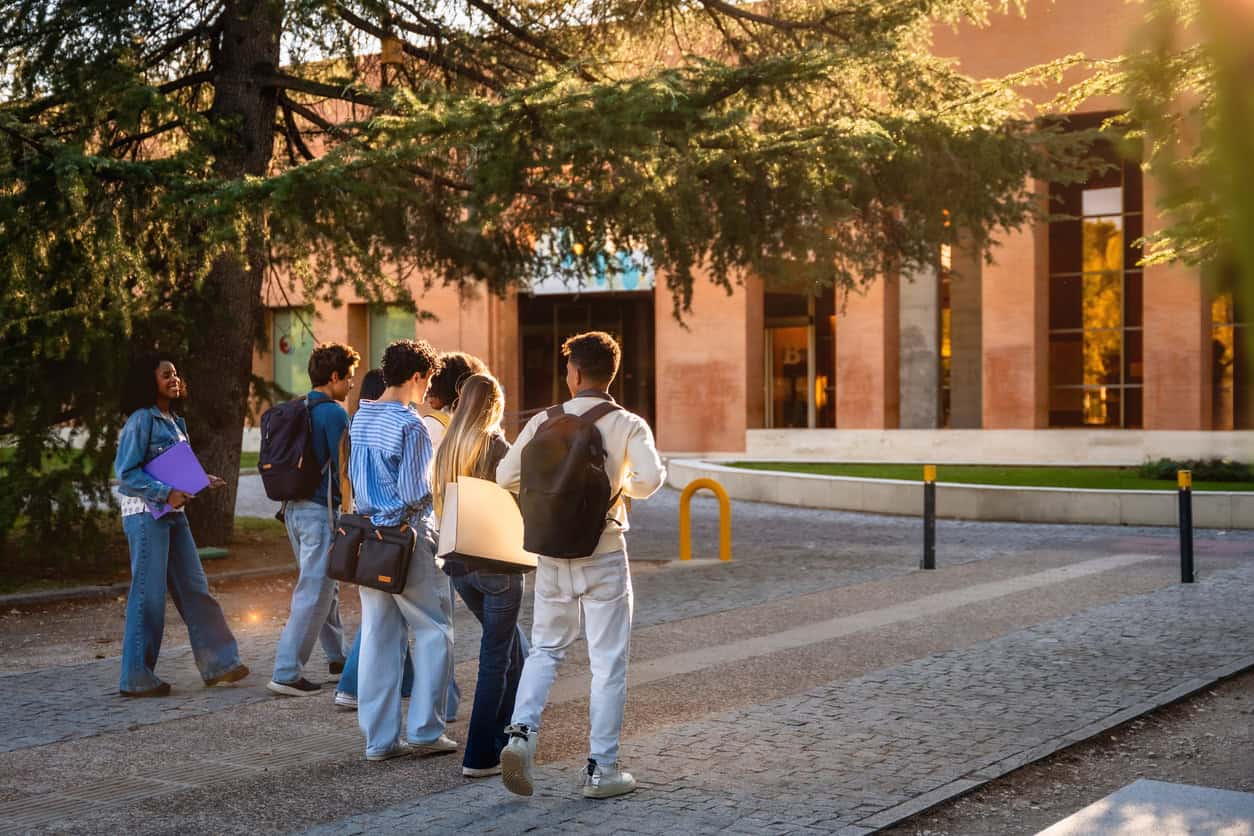

Sooraj Sahani, an international student from Nepal, remembers the moment when he learned that Texas State University had accepted him on a full scholarship. It meant that he could afford to pursue his dream of becoming a physicist.
For out-of-state students, Texas State can cost up to $25,000 in tuition and roughly $18,000 for housing, food, and other expenses per year. International students must also shoulder costs including health insurance, visa processing fees, and travel expenses. In addition, many international students remain in the US over the summer, meaning housing costs pile up year-round.
Before they get to the US, prospective students must pay $350 in SEVIS fees and $185 in visa application fees – both non-refundable if their visa is rejected. What’s more, the Trump administration is set to bring in a further $250 ‘visa integrity fee’, though this is yet to be implemented.
As such, the total cost of graduating from a US public or private university and living there for four years can exceed $185,000. Because international students don’t qualify for federal aid or federal loans, many have no choice but to pay the full fee. That’s unless they can secure a major scholarship or institutional aid.
Sahani, now a rising junior, went into his freshman year on a full scholarship because of his high grades and standardized test scores. He then secured two more scholarships through the school’s physics department, allowing him to pay for the additional classes beyond the 18-credit limit of a full-time student.
Two Nepalese international students who Sahani lives with also secured large scholarships for Texas State, he said. During his college search, Sahani only considered schools that had scholarship opportunities for international students.
“The most important thing as an international student is to first look into which schools give scholarships and which you might qualify for,” he said.
Scholarships and aid for international students are often competitive and can be hard to find, says Nat Smitobol, a college admissions counsellor at the educational consultancy IvyWise. It costs more for a college to fully fund an international student than a domestic student, because the school doesn’t get any federal support.
Despite that, some colleges give several million dollars a year in international student aid. Wesleyan University in Connecticut provided an average of $90,100 in aid to 108 international students during the 2024 to 2025 school year, topping US News and World Report’s list of schools that gave the most average international aid. Williams College in Massachusetts came in second, with an average of $88,400 in aid for 123 international students, followed by Duke University in North Carolina, with an average of $88,270 for 190 students.
Over half of the schools on the top 20 list are medium-sized liberal arts colleges, which Smitobol said doesn’t surprise him. While international students tend to gravitate toward larger, more well-known universities, these schools have fewer incentives for providing large international aid packages.
“When you’re, let’s say, NYU [New York University] or USC [University of Southern California], you have so much visibility around the world that you don’t really need merit-based scholarship or international aid to attract an applicant pool,” he said. “You can fill the spots with students that aren’t applying for financial aid.”
On the other hand, smaller, less selective colleges often try to attract highly gifted students – international or domestic – to boost their national rankings. The same applies to research universities aiming to boost their global acclaim. If any student has grades and standardised test scores far above the college’s average, it could be an incentive for the college to provide up to a full ride in institutional aid.
“You raise your ability to get aid the more above the median that you are, whether you’re a domestic student or an international student,” Smitobol said.
The US is at risk of making a faulty assumption that our appeal can survive these small indignities that we’re putting students through
David Weeks, Sunrise International
Where to look for scholarships as an international student
Smitobol suggests looking at college websites to find merit-based scholarship opportunities. While some are open only to US residents, others, like Sahani’s scholarships at Texas State, are open to international applicants as well.
Some schools also offer scholarships specific to international students. That includes Wesleyan University’s African Scholars program, which has given full scholarships to 10 African students who apply for financial aid each year since 2023. Wesleyan also has a similar scholarship, the Freeman Asian Scholars program, for Asian students.
Africa has a growing youth population, and with it comes a large concentration of young talent and innovation, said Amin Abdul-Malik Gonzalez, the school’s vice-president and dean of admissions and financial aid. However, the high cost of a US degree – such as Wesleyan’s nearly $76,000 per year in undergraduate tuition – can be an obstacle. Gonzalez believes the scholarships not only bring talent to the school, but give domestic students a chance to learn about other cultures.
“They make it possible for all students, especially those from the United States who don’t study abroad, to engage with other cultures without leaving campus,” he said in an email.
Around 10% of Wesleyan University’s student body is international, from 64 different countries. Wesleyan University meets all demonstrated financial needs “in full” for its undergraduate international students, according to Gonzalez – which would make it one of only a handful of US schools.
Other ways to lower the cost
In addition to scholarships through schools, there are hundreds of international student scholarships through other organisations. The company Envisage International maintains a database, IEFA.org, where international students can search for scholarships across multiple host countries.
In an interview with The PIE News, Envisage’s president said the website aims to be the most comprehensive and user-friendly resource for international students seeking aid. The website allows students to filter for their native country, host country, and field of study to find scholarships best suited for them.
International students can also look for work opportunities to lower the cost of attendance. Students on an F-1 visa are allowed to work up to 20 hours per week on campus while classes are in session and up to 40 hours per week during breaks.
Sahani has worked several on-campus jobs at Texas State, including as a teacher’s assistant for a lab and a class. He says working has allowed him pay for an apartment over the summer and other expenses.
“If you are in need of money to pay housing bills, it’s good to look for a job in dining halls. Then, as they complete their courses, they can also apply to be a TA, which is what I did,” he said.
Students turning to other countries for higher education
Despite aid options being available, international students may come across other obstacles to studying abroad in the US.
Last fall, new international student enrolment in the U.S. dropped by 17%, according to the Institute of International Education. It came after President Donald Trump’s near month-long pause on visa interviews, his war against many of the nation’s most prestigious universities, and his travel ban impacting 39 countries.
Recently, the US State Department unveiled plans to halt visa processing at 30 African embassies. However, even before the Trump administration, international student advocacy groups have raised alarms about high rates of visa denials, particularly for African and Asian students, and long wait times to schedule visa interviews at embassies.
Those challenges have forced some students to look to other countries for higher education, especially countries offering financial incentives.
Over the past decade, the number of African students in Chinese universities has grown tremendously, in part because of government-funded scholarships. China has pledged to provide 50,000 full scholarships to African students, along with 60,000 fully funded training programs, under its 2025 through 2027 action plan.
China has become many African nations’ largest trading partner over the past decades. To further its economic relationship with Africa, the Chinese government is recruiting and training young African talent, said David Weeks, co-founder and chief operating officer of Sunrise International, which specializes in cross-border marketing between the U.S. and China, including for universities.
“China has taken a very holistic view of its engagement with African countries, and a big part of that is people-to-people exchanges,” he said.
Like much of the world, English is a common secondary language for students to learn in Africa, if they’re not already native English speakers. To boost recruitment, some Chinese universities have started offering degree programs entirely in English.
In addition, China’s online scholarship application portal is available in English, along with French, Arabic, and Indonesian. Currently, the website shows 3,820 scholarships, including those run by the federal government, available for English-language programs.
Making the most of Chinese scholarship opportunities
As Weeks explains, applying for Chinese scholarships often involves more notarisation and fewer personal essays compared to US scholarships.
He suggests that, before applying, students should research whether their country has a high demand for the program they’re interested in. It can often be difficult to secure a job in China if someone isn’t fluent in Mandarin Chinese.
He also cautions that universities in China often offer fewer on-campus services for international students compared to universities in Western countries. Many US schools have an international services office to help students with cultural adjustment, understanding healthcare options, and setting up a bank account. However, these services are rare for Chinese universities, which tend to have much fewer international students.
“Many universities in the UK and Australia can be as much as 30% international. There are very few universities in China that are more than 5% international,” Weeks said.
War for global talent
China is far from the only country recruiting international students. There are also government-sponsored scholarship programs in Japan, South Korea, New Zealand, Turkey, and others.
Smitobol from Ivywise said that, while many US institutions have traditionally been viewed as highly prestigious, other countries also have elite universities, where international students graduate with fewer loans.
“If schools are recognising the strength of an international population, absolutely, I think students should go where the money is and where it makes sense,” he said.
The US still hosts more international students than any other country, totalling nearly 1.2 million for the 2024/2025 school year. Weeks warns that, as more countries provide financial incentives to international students, the prestige of US schools alone won’t be enough to attract the brightest students.
“I think there’s this broader tension of which countries are going to be able to recruit the best and the brightest. I think the US is at risk of making a faulty assumption that our appeal can survive these small indignities that we’re putting students through,” he said.